


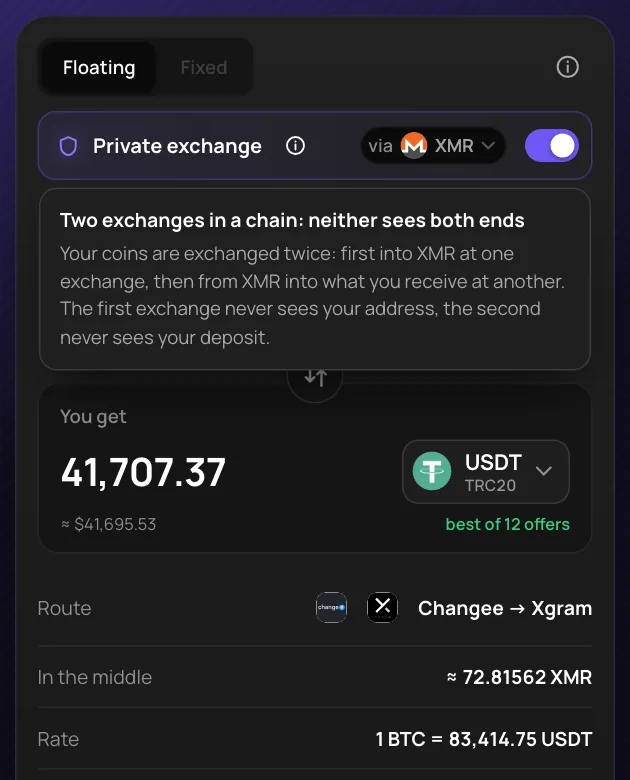
Short answer: the private mode of Changerella App turns one swap into two. Exchange A takes your coins and converts them into Monero (or another coin in the middle), sending it straight to a deposit address of exchange B; exchange B converts that into what you want and pays your address. A never sees your payout address, B never sees your deposit. No sign-up, no custody by Changerella, one deposit from you — the rest happens by itself in about 40 minutes.
Key facts
| What | Private (two-leg) crypto swap inside Changerella App, a non-custodial aggregator of instant exchanges |
|---|---|
| Link | app.changerella.com/private (Russian: /ru/private) |
| Launched | 21 September 2026 |
| How it works | Two independent exchanges chained through a middle coin; the two legs are never the same provider |
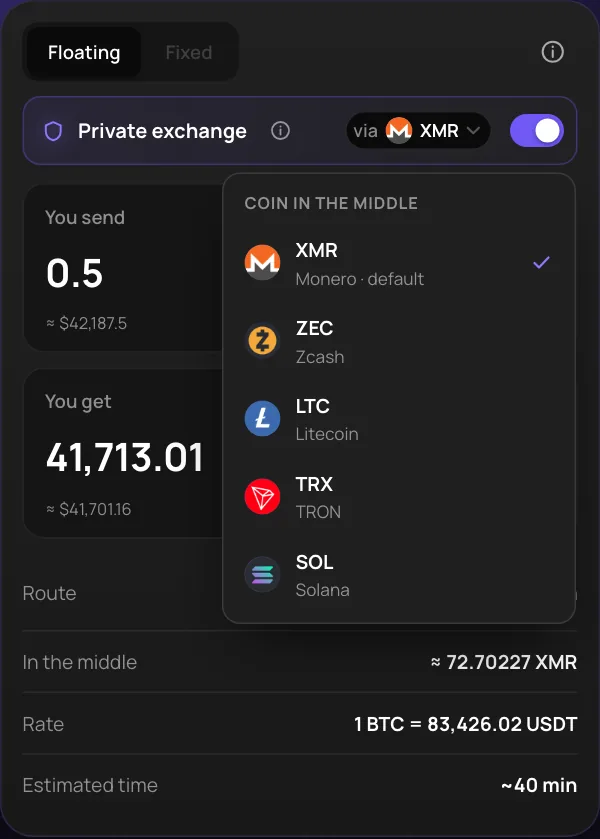
| Coin in the middle | XMR (default), ZEC, LTC, TRX, SOL |
| Rate type | Floating only |
| Typical time | ~40 minutes (a direct swap is ~20) |
| Typical cost | 0.5–1% below the best direct swap on a liquid pair (snapshot below) |
| Account | None. Orders are stored in your browser and can be found by ID |
| Custody | None. Changerella never receives your funds |
The problem it solves
An ordinary instant swap is simple and fast, but it produces one very tidy record: this deposit, from this address, turned into that payout, to that address. The exchange holds both ends in one row of its database. Whoever gets access to that row — through a data request, a leak or a compliance inquiry — gets the whole story at once.
Private mode removes that row. It does not rely on any exchange promising to forget things; it simply makes sure that no single exchange ever had both halves in the first place.
How a private swap works
- Changerella quotes both legs. Leg A (
BTC → XMR) is asked of every connected exchange; the best few offers are combined with the best offers for leg B (XMR → USDT). Routes where A and B would be the same provider are thrown out. - You pick a route — for example Changee → Xgram — and enter your payout address. Nothing else is required.
- Order B is created first. Exchange B gets your payout address and hands out its deposit address for XMR.
- Order A is created with B's deposit address as the payout. Exchange A only ever sees "send XMR to this address" — an address that belongs to another exchange, not to you.
- You send one deposit to A. A converts and pays XMR to B, B converts and pays you. The status page follows both legs: Deposit → In XMR → In USDT → Done.
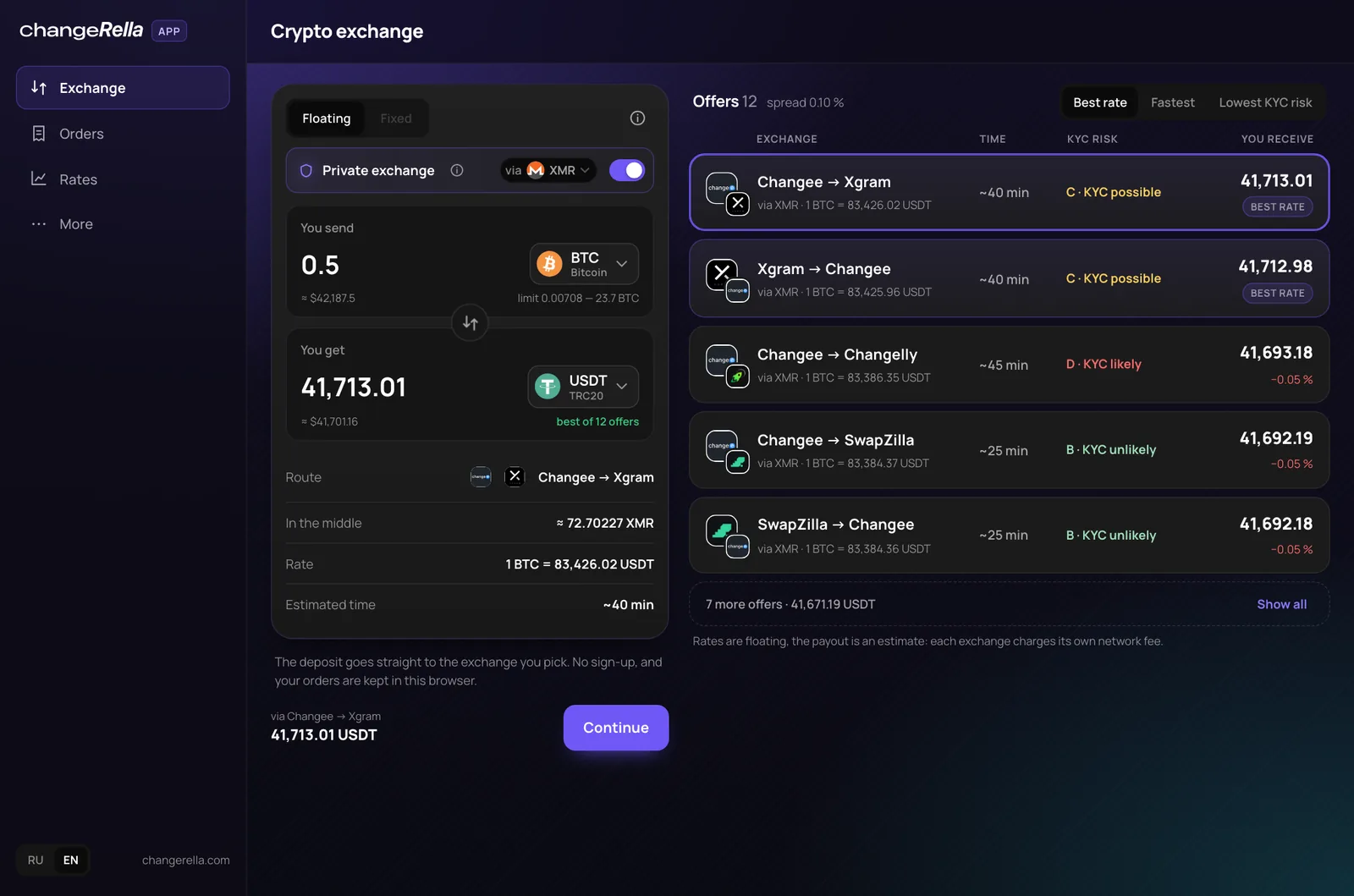
The deposit address of exchange B is never shown to you, on purpose: sending money there by hand would break the chain. You only ever see one address — the deposit of leg A — exactly as in a normal swap.
What each exchange sees
| Exchange A | Exchange B | Changerella | |
|---|---|---|---|
| Your deposit address and amount | Yes | No | Order data only |
| Your payout address | No — only B's deposit address | Yes | Order data only |
| Holds your funds | During leg A | During leg B | Never |
| Can link both ends by itself | No | No | Yes — it keeps the pair of orders to show you the status |
Changerella itself does know that the two orders belong together — otherwise it could not show you one status page. It holds no account, no email and no identity documents for that record, and it never holds the money; but it is fair to say so plainly rather than pretend the link exists nowhere.
Why Monero in the middle — and when to pick something else
The middle coin is the one transfer that happens between the two exchanges. If it moves on a transparent chain, anyone can follow the amount from A's hot wallet into B's. On Monero, amounts and addresses are hidden by default, so that hop is not readable from the outside. That is why XMR is the default.
| Middle coin | Privacy of the hop | Speed | When it makes sense |
|---|---|---|---|
| XMR (default) | Highest: amounts and addresses hidden | ~20 min of confirmations | The normal choice |
| ZEC | Depends on whether the exchanges use shielded addresses | Fast | When XMR routes are unavailable for your pair |
| LTC | Transparent chain; the separation comes from using two companies | Fast, cheap | When the price matters more — usually the cheapest route |
| TRX, SOL | Transparent chains | Very fast | Speed first, or when other middles are off for the pair |
Coins that the exchanges cannot both accept and pay out for your pair are greyed out in the menu, and a middle coin can never be the same as either end of the swap. If you want the background on why XMR has become harder to buy directly, see where to swap Monero after the delistings.
What it costs: a real snapshot
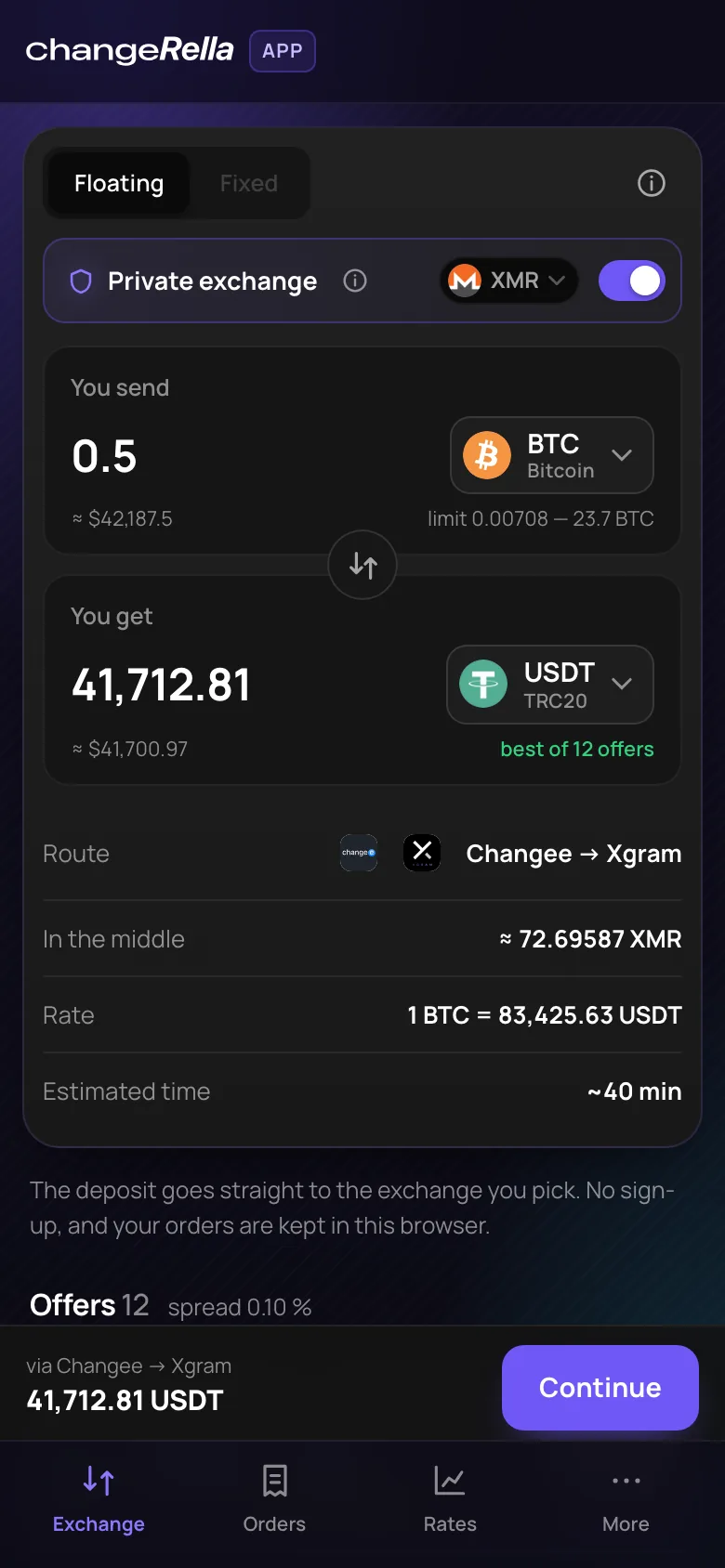
Two exchanges means two spreads. We measured it on the same pair at the same moment on 21 September 2026 (0.5 BTC → USDT TRC20, floating rate, best offer in each mode):
| Mode | Best payout | Difference | Time |
|---|---|---|---|
| Direct swap | 42,136.31 USDT | — | ~20 min |
| Private via LTC | 41,943.27 USDT | −0.46% | ~40 min |
| Private via XMR | 41,727.77 USDT | −0.97% | ~40 min |
Rates move every minute, so treat these numbers as an order of magnitude, not a price list: on liquid pairs privacy costs roughly half a percent to one percent and twenty extra minutes. There is no Changerella fee on top — both legs are paid at the exchanges' own rates.
How to make a private swap, step by step
- Open app.changerella.com/private. The switch is already on; on the main screen it is the "Private exchange" row.
- Choose what you send and what you get, and enter the amount. The limits of leg A are shown under the amount.
- Optionally tap "via XMR" and pick another middle coin.
- Pick a route in the list, or keep the best one, and press Continue.
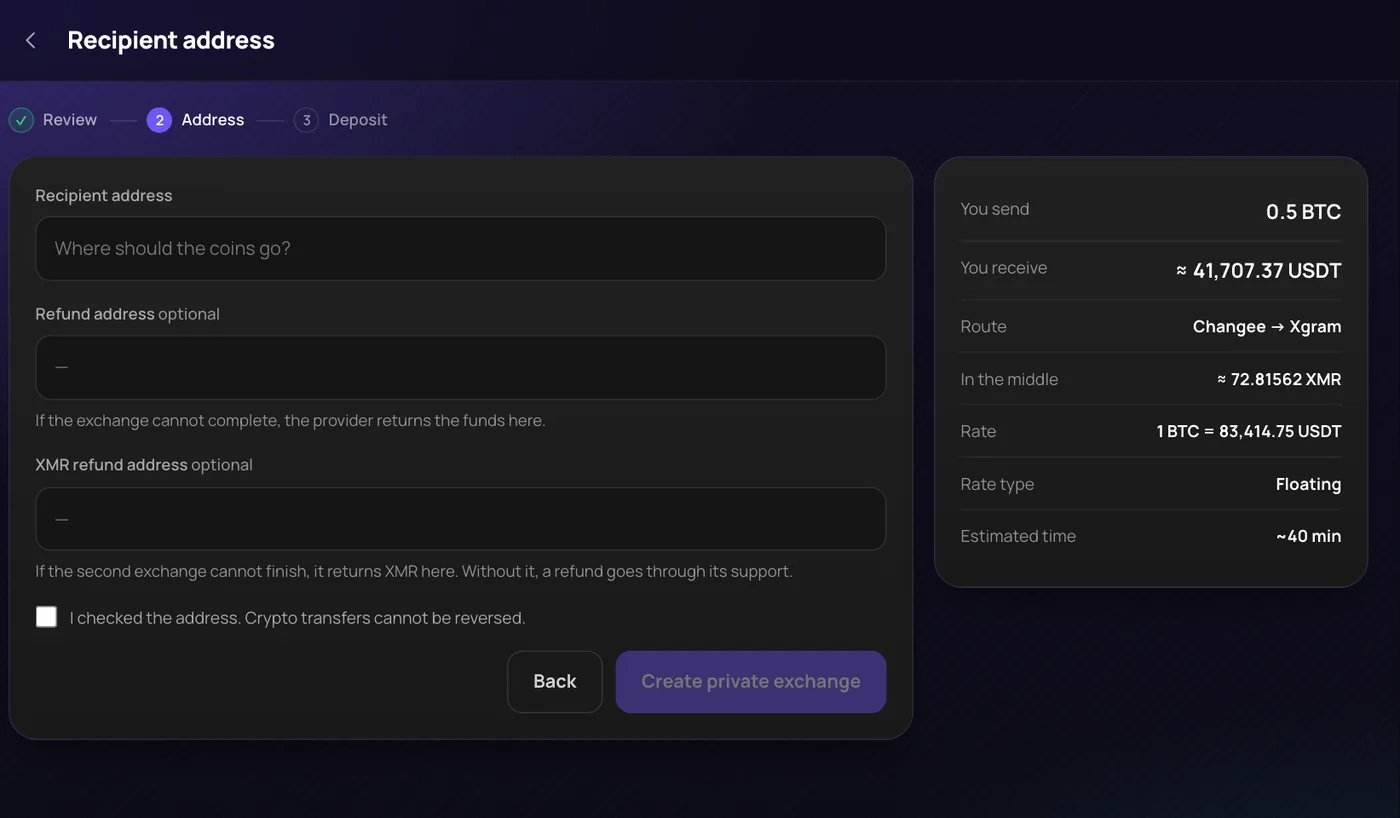
- Enter the recipient address. The two refund addresses are optional but recommended: one for your own coin, one for the middle coin in case exchange B cannot finish.
- Tick "I checked the address", press Create private exchange and send the deposit to the address shown.
Honest limits
- It is not a mixer and not invisibility. It removes the single record that links both ends. It does not hide that you sent BTC to an exchange, and the public ends of the chain — your BTC deposit and your USDT payout — are still on public blockchains.
- Timing and amount still exist. A payout that arrives 40 minutes after a deposit of roughly the same value is a weak statistical hint for someone watching both exchanges' hot wallets. They serve thousands of users, which is what makes the hint weak — but it is not zero.
- KYC is still each exchange's decision. Each leg carries its own A–D KYC rating. If either exchange asks for verification, that leg waits. Sorting by "Lowest KYC risk" helps; it cannot promise anything. Background: no-KYC exchanges in 2026.
- Floating rate only. Two fixed rates cannot be chained: the second would expire while the first is still running.
- Leg B has its own deposit window. If leg A is slow and B's window closes, the middle coin arrives to an expired order and comes back through B's support — or straight to your middle-coin refund address if you filled it in. That is why that field is there.
- Different names are not always different companies. The rule "A ≠ B" compares providers as they are connected; some brands share infrastructure. If that matters to you, pick a route with two unrelated names.
Who it is for
- People paid in crypto who do not want the payer to be able to follow the money to their savings wallet.
- Anyone moving funds between their own wallets who would rather not hand one company the map of both.
- Monero users who need XMR in the middle but not at either end — without buying it on a centralised exchange first.
If you are new to privacy tools in general, start with how to exchange crypto anonymously; if Monero itself is the goal, read how to swap Bitcoin to Monero without KYC. The rest of the app — the ordinary comparison of a dozen exchanges — is covered in the Changerella App overview, and it also swaps crypto into tokenized stocks.
FAQ
What is a private crypto exchange on Changerella?
It is a swap split into two orders at two different instant exchanges, chained through a middle coin such as Monero. The first exchange sends the middle coin directly to the second one's deposit address, so neither exchange knows both your deposit and your payout address.
Where do I find it?
At app.changerella.com/private — the exchange screen opens with private mode already on. On the main screen it is the "Private exchange" switch above the amount.
Do I have to make two deposits?
No. You send one deposit to the first exchange. The transfer between the two exchanges and the final payout happen automatically.
How much more does a private swap cost?
You pay two exchange spreads instead of one. On 21 September 2026 a 0.5 BTC to USDT swap paid 0.46% less via LTC and 0.97% less via XMR than the best direct swap. Changerella adds no fee of its own.
How long does a private swap take?
Usually around 40 minutes, roughly twice a direct swap: two exchanges process in turn, and Monero needs about 20 minutes of confirmations.
Why is the fixed rate unavailable in private mode?
A fixed rate is valid only for a limited window. With two legs in a row, the second fixed rate would expire while the first leg is still being processed, so private swaps use floating rates only.
Which coins can be used in the middle?
XMR by default, plus ZEC, LTC, TRX and SOL. A coin is offered only if the exchanges can both receive and pay it out for your pair, and it cannot be the same as either end of the swap.
Is a private swap anonymous?
It removes the single record linking sender and recipient, which is the most common way swaps are traced. It does not hide your public deposit and payout transactions, and each exchange may still request KYC under its own rules.
Does Changerella hold my funds?
No. Changerella is non-custodial: your deposit goes to the first exchange, the middle coin goes from the first exchange to the second, and the second pays your address.